Inside Swaraj Hansa: Designing an Agentic, Multi-Tenant SIEM You Can Actually Trust
Most "AI SIEM" demos put a language model in the critical path and hope for the best. In a managed security service, where one platform watches many clients at once, that is not good enough. The question is not "can an LLM summarise an alert" — it clearly can. The question is: can you put one into a production detection pipeline without letting it leak data across tenants, invent verdicts, or be talked out of its job by a crafted log line?
Swaraj Hansa is ESDS's answer to that, and I architected and led the build of it. This is how the system is put together and, more importantly, where the model is deliberately *not* trusted.
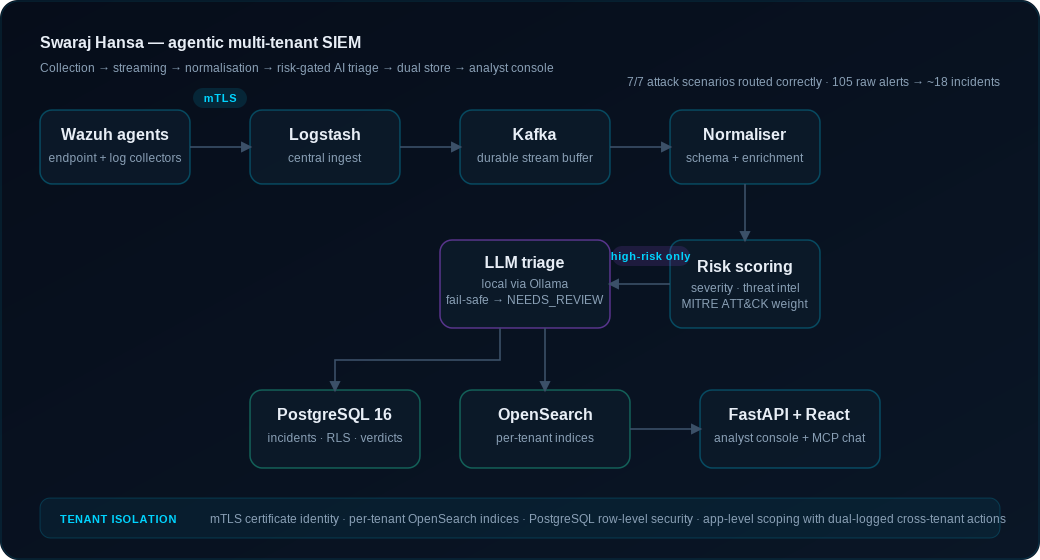
The pipeline
Telemetry flows through a deliberately boring, auditable path:
- Collection. Wazuh agents ship endpoint and log data to a central Logstash over mutual TLS — the client's identity is its certificate, not a header it can forge.
- Streaming. Kafka gives the system a durable buffer, so a burst of events or a slow downstream never drops data on the floor.
- Normalisation. Events are coerced into a common schema and enriched with threat intelligence (AbuseIPDB, VirusTotal) before anything looks at them.
- Dual store. Incidents and verdicts live in PostgreSQL 16; raw, searchable events live in OpenSearch, with one index per tenant.
- Console. Analysts work in a FastAPI + React application with a tenant-scoped chat assistant.
Nothing above is novel on its own. The design work is in the two places the AI touches: the triage path and the chat assistant.
The model does not decide — a risk score does
A language model is expensive, slow, and non-deterministic. You do not want it running on every alert, and you do not want its opinion to be the final word. So before any model is invoked, a deterministic risk score runs: severity, threat-intel reputation, and MITRE ATT&CK weighting combine into a number. Only high-risk alerts are handed to the LLM at all.
When the model does run, its authority is boxed in:
- It receives untrusted log data inside explicitly labelled, untrusted prompt blocks — sanitised first (control characters stripped, known injection phrases neutralised, fields truncated to 2,000 characters).
- It must answer in a fixed JSON verdict schema. Anything malformed, uncertain, or out of range fails safe to
NEEDS_REVIEWrather than being guessed. - Every verdict lands in an analyst review queue that records the human decision. The model proposes; a person disposes.
The chat assistant is scoped, not clever
The analyst-facing assistant is where "excessive agency" usually sneaks in. Here it is constrained on every side:
- Its tools are tenant-scoped and enforced server-side via the Model Context Protocol — the model cannot reach another client's data even if it is asked to.
- A topic filter runs before the model does, so off-scope requests never reach it.
- Answers are grounded in tool results, it does not disclose detection rules, and it cannot override a stored verdict.
Four layers of tenant isolation
In a multi-client MSSP, a cross-tenant leak is the worst thing that can happen. So isolation is not one control, it is four, each independent of the others:
- Ingress identity from mTLS certificates — unknown clients are dead-lettered, not guessed at.
- Per-tenant OpenSearch indices — separate data stores, not a shared index with a filter.
- PostgreSQL row-level security (RLS) — the database itself refuses cross-tenant reads.
- Application-level scoping, with any cross-tenant action dual-logged.
And because inference runs locally via Ollama, no prompt data — no logs, no customer telemetry — ever leaves the environment to reach a third-party API.
Did it actually work?
A design is a hypothesis until you test it. End to end, the pipeline took 105 raw alerts down to ~18 deduplicated incidents, and routed 7 out of 7 seeded attack scenarios to the correct queue. A load-test harness exercises it from 100 up to 5,000 EPS against a 100–1,000 EPS per-tenant design target, and tiered retention (Kafka 24h–14d, OpenSearch 30–180 days, incidents ~1 year) keeps storage honest.
What I would tell anyone building one
If you take one thing from this: decide what your model is allowed to be wrong about before you write a line of prompt. In security, the answer is usually "very little." Put a deterministic gate in front of it, a human behind it, a strict schema around it, and hard tenant boundaries underneath it — then the LLM becomes a genuine force multiplier instead of a liability you have to apologise for later.
*Swaraj Hansa is a managed SIEM product at ESDS. You can read the official product overview on the ESDS site.*